Friction Is the Whole Game: Zoning Your Kitchen for Four Cycles of Fat Loss
Walk into your kitchen right now and don't touch anything. Just look. Whatever your eyes land on first — the fruit bowl, the open bag of chips, the dish rack, the stack of mail — is quietly casting a vote about what you'll eat in the next ten minutes. You didn't choose that vote. You just built the room it lives in.
That's the whole idea behind kitchen zoning. Not a purge, not a color-coded label maker situation, not a spreadsheet taped inside a cabinet door. Just a deliberate answer to one question: what does this room make easy?
Why the Meal Chart Loses to the Room
Every fat-loss plan on earth assumes a moment of decision. You open the app, you check the plan, you weigh the rice, you cook the thing. But that's not how a Tuesday night actually goes. Tuesday night goes like this: you're tired, it's dark by 5:30, and you're standing in front of an open door deciding with your hands, not your head.
Behavior researchers call this friction, and it's boring in the best possible way. Small barriers — a cabinet, a step, a lid — reliably shift what people reach for. Small conveniences do the same thing in reverse. You are not going to out-discipline a room that's been arranged against you.
The good news: the room is yours. You can rearrange it.
Zone 1: The Counter Is Cycle 1 Territory
Cycle 1 is your foundation phase — the stretch where you're re-establishing rhythm, not chasing a number. The counter should vote for that rhythm every time you walk past it.
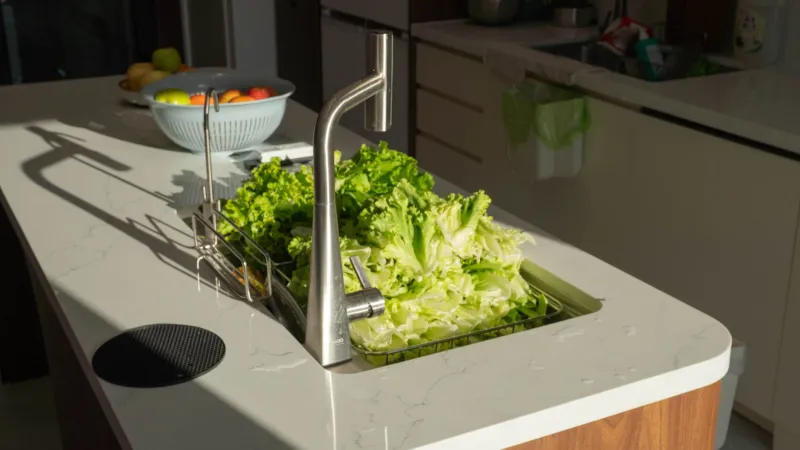
What belongs on the counter: the fruit bowl you actually like, a cutting board that's clean and reachable, the coffee setup you enjoy, and one appliance you'll genuinely use this week. What does not belong: the bulk snack bag you opened "just to put some in a bowl," the candy dish from Halloween that's now a permanent fixture, the cereal box you'd have to put away anyway.
Here's the test. If you had to eat whatever sat on that counter for a week, would you be fine? If the answer is no, the counter is lying to you. Fix it before you fix your macros.
Zone 2: The Fridge Is Cycle 2's Working Capital
Cycle 2 is the habit phase — you're building skills, not white-knuckling a deficit. That means the fridge needs to support assembly, not just storage. The middle shelf, at eye level, is prime real estate, and it should hold things that are already halfway to a meal.
Think washed produce in a container you can see through. Cooked protein from Sunday that you'll actually finish by Wednesday. A jar of something with acid in it — pickled onions, hot peppers, lemon — because a plain chicken breast becomes dinner the second it has a personality. Eggs. Cheese you'll grate. A bag of greens that isn't slowly dying in the crisper drawer you never open.
The crisper drawer is where good intentions go to become slime. Move the vegetables up. Move the stuff you're avoiding down and back. Nobody's banning anything; you're just making the produce the path of least resistance.
Zone 3: The Pantry Is Cycle 3's Guardrails
Cycle 3 is where the deficit gets real, and this is the phase where people make the mistake of an all-or-nothing pantry. Empty shelves, one heroic week, then a 9 p.m. run to the corner store. Skip that movie.
Instead, treat the pantry as a set of guardrails. Keep the staples that make a fast, satisfying plate: canned beans, tuna, tomatoes, rice, oats, broth, frozen shrimp in the freezer next door. Keep the treats too — but in a container, on a high shelf, in a quantity you chose on purpose. A bag of chips you have to retrieve and open is a different food than a bag of chips sitting open on the counter.
The trick is portioning at the point of storage, not the point of hunger. Buy the snack-size, or split the big bag into smaller ones the day you get home. That's not restriction. That's just refusing to make a decision while tired.
Zone 4: The Prep Shelf Is Cycle 4's Landing Pad
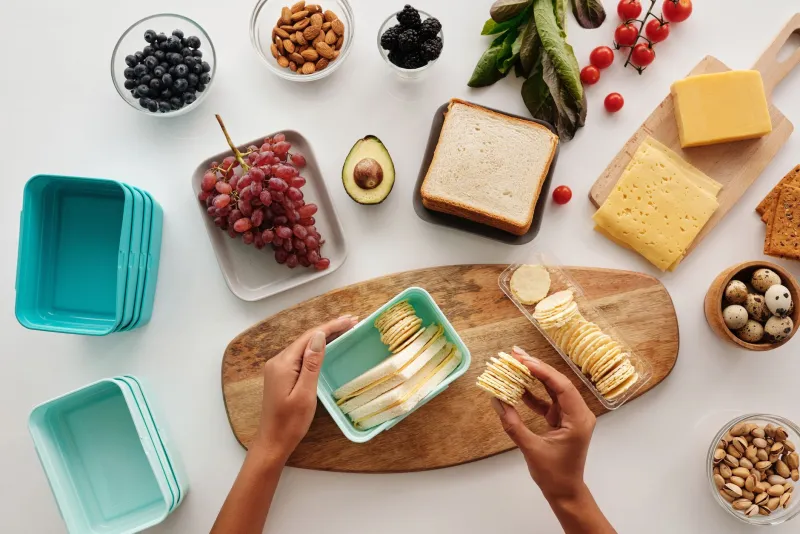
Cycle 4 is the maintenance phase — the one everyone skips and then wonders why the other three keep resetting. Cycle 4 needs a shelf, literally, where the week's prep lands. Containers, sheet pans, a stack of lids that match. This is the zone that makes the whole system repeatable, because it's where a good week becomes visible instead of theoretical.
If your containers are mismatched and buried, prep feels like a chore. If they're stacked and ready, prep is fifteen minutes and a podcast. Small difference in effort, enormous difference in whether it happens in February.
The Zones Shift With the Cycles
You don't rebuild the kitchen four times a year. You rotate. When you move from Cycle 3 back into Cycle 4, the pantry guardrails loosen and the prep shelf gets more attention. When you enter Cycle 1 again, the counter gets cleared and the fridge gets simplified. It's a ten-minute reset, not a renovation.
One honest note: none of this works if the kitchen is full of food you don't actually like eating. A counter full of apples you bought out of obligation is just a guilt bowl. Stock the room with things you'd choose on a good day, and the room will start choosing them for you.